6.5kW Hybrid Solar Inverter: AC Input, Dual Output & Feed-In
6.5kW Hybrid Solar Inverter: AC Input, Dual Output and Grid Feed-In
A 6.5kW hybrid solar inverter should be selected from three electrical interfaces — AC input, dual AC output and grid feed-in — before any other specification is compared. On the GOTOSOLAR SYP6.5KW48V, the AC input accepts 208/220/230/240 VAC, rated output is 6.5 kW with 12 kVA surge power, output is pure sine wave, and the transfer time is 10 ms in both normal and UPS modes. Grid feed-in is supported, the 48 V low-voltage battery bus accepts lithium and lead-acid packs, PV/AC charge current is capped at 120 A, and the MPPT window runs from 60 to 450 VDC with a maximum PV open-circuit voltage of 500 VDC.
Those eight numbers decide whether a residential, commercial, RV or telecom design will actually work. They are also the numbers most often skimmed, misread or copied from a neighbouring model. This guide walks through each interface in the order a system designer or importer should read it, then converts the parameters into a step-by-step selection sequence, use-case fit, and a verification checklist for the datasheet and certificate pack.
Problem Definition: Where 6.5kW Hybrid Inverter Specifications Get Misread
Most hybrid inverter selection errors do not happen on the PV side. They happen at the AC interface, because the AC interface is described in shorthand on most datasheets and then interpreted differently by the installer, the distributor and the utility.
- AC input is assumed to be universal. A unit rated at 208/220/230/240 VAC is a four-voltage specification. A buyer who only reads “230 VAC” may order into a 208 VAC single-phase market and discover at commissioning that the acceptance window is the wrong one for the site.
- Dual output is treated as a marketing feature. Dual AC output is a wiring decision. If the load schedule is not split before the inverter is ordered, the second output becomes an unused terminal block.
- Grid feed-in is assumed to be automatic. Feed-in capability describes what the inverter can do, not what the local utility permits. Export approval, metering and grid-code settings sit outside the inverter.
- The PV voltage window is read as a single number. An MPPT range of 60–450 VDC and a 500 VDC open-circuit ceiling are two different limits. String voltage must sit inside the MPPT window across the whole temperature range, and never approach 500 VDC in cold weather.
- Charge current is ignored. A 120 A maximum PV/AC charge current is a ceiling, not a target. The battery datasheet sets the real limit, and the inverter must be set below it.
Each of these misreads produces the same commercial outcome: a specification that looks correct on a quotation, and a system that needs rework after the container lands.
Industry Background: Why the Single-Phase 6.5kW Class Still Matters
The global solar hybrid inverter market was valued at USD 10.7 billion in 2024, according to Grand View Research. Within that total, the global residential solar hybrid inverter segment was valued at USD 4.55 billion in 2023, based on the residential market assessment published by Markets and Data. Three-phase hybrid inverters held a dominant revenue share of over 61.3% in the global market in 2024, again per Grand View Research, which reflects large commercial and utility-adjacent deployments.
The revenue skew toward three-phase hardware does not remove the single-phase backup requirement. Households, small commercial premises, mobile installations and remote sites still need a single-phase hybrid unit that behaves like a UPS. Buyers frequently search for a 6 kW single phase hybrid solar inverter while the specification they actually need sits at 6.5 kW rated with 12 kVA surge — a reminder that the model class, not the search phrase, should drive the design.
Two regulatory anchors frame the category. UL 1741 is the primary safety standard for grid-connected inverters in North America, and IEC 62109 is the international standard for PV power converters. Both bear directly on grid feed-in: a unit sold into a market with export rules will be asked for the corresponding listing or certification for the exact model and grid code. For customs classification, solar inverters fall under HS Code 8504.40 as static converters.
Detailed Solution: Reading the Eight Parameters That Define a 6.5kW Hybrid Inverter
1. AC input: 208/220/230/240 VAC rated input
The AC input is the inverter’s contract with the grid. A rating of 208/220/230/240 VAC means the unit is specified across four nominal single-phase grid voltages, which covers North American 208 VAC single-phase derived service as well as the 220–240 VAC range common in Africa, the Middle East, South America, South-East Asia and CE-certified European markets. For an importer holding stock across several of those regions, one voltage specification reduces SKU proliferation.
Read that figure together with the surge rating before confirming an order. A 6.5 kW rated / 12 kVA surge hybrid inverter is designed for loads that start hard — pumps, compressors, air conditioners, motors — because the surge window covers the inrush current that a continuous rating cannot. Matching a 12 kVA surge unit to a 6.5 kW continuous load profile gives headroom without oversizing the entire system.
2. Dual AC output: two circuits, one decision
A dual output hybrid solar inverter provides two AC output channels instead of one. In practice this lets the installation separate circuits at the distribution board — for example a critical group that must stay energised and a non-critical group that can be shed when the battery state of charge falls. This is the parameter that turns a hybrid inverter from a whole-house switch into a load-management tool.
Dual output only creates value if the load schedule is produced before purchase. Document which circuits go to which output, what each output must carry in backup, and how the two channels behave when the grid fails. For a residential hybrid solar inverter installation, the split typically follows comfort loads versus essential loads; for a commercial hybrid solar inverter it follows revenue-critical equipment versus general lighting. Confirm the exact backup behaviour of each channel in writing with the manufacturer, because datasheet layouts differ.
3. Pure sine wave and 10 ms transfer in normal and UPS modes
Output waveform and transfer time are the two specifications that determine whether a hybrid inverter can act as a UPS backup hybrid solar inverter. Pure sine wave output is required by motors, compressors, pumps, and by electronics with power-factor-corrected supplies; it is also the waveform most appliance warranties assume.
A 10 ms switch time, specified in both normal and UPS modes on the SYP6.5KW48V, keeps computers, routers, servers and control equipment running through a grid failure without a reboot. The distinction matters: some units publish a fast transfer figure for one mode only. When the datasheet lists both modes, the number can be applied to the actual operating condition of the site.
4. Grid feed-in: capability versus permission
Grid feed-in support means the inverter can export surplus energy to the grid rather than curtailing it. For an off grid on grid hybrid solar inverter, the same hardware that backs up a house during an outage can also reduce the electricity bill in daylight hours — but only where the utility allows export, the meter supports it, and the grid code settings in the inverter are configured for that market.
Treat feed-in as a project-level approval, not a product feature. Before ordering a container, confirm the export rules for the target market, ask the manufacturer which grid code the unit is configured for at dispatch, and confirm how export-limiting configuration is handled where export is not permitted. The inverter’s UL 1741 listing status — the primary safety standard for grid-connected inverters in North America — belongs in that same conversation if the destination is North America.
5. Battery compatibility on the 48 V low-voltage bus
The SYP6.5KW48V is a 48 V low-voltage hybrid solar inverter, compatible with both lithium and lead-acid batteries. That flexibility is what makes the model usable across mature and emerging markets in the same catalogue: lead-acid remains widely stocked in price-sensitive regions, while lithium is increasingly specified where cycle life and usable depth of discharge drive the decision.
Compatibility is not the same as plug-and-play. For lithium packs, confirm the BMS communication protocol against the manufacturer’s compatibility list before specifying a brand; for lead-acid, confirm the charging profile and temperature compensation. Independent evidence of lithium compatibility exists at project level: in a large-scale residential solar storage project in South Africa, the product demonstrated compatibility with lithium batteries while operating stably at 45°C without derating.
6. Maximum 120 A PV/AC charge current
A 120 A maximum PV/AC charge current is the highest charging current the unit will deliver, whether the energy comes from the array or from the AC input. It sets three things: how fast a depleted bank can be recharged, how large a battery bank can be supported without throttling, and what the AC-side demand will be when grid charging runs at full current.
Specify the inverter below the battery’s maximum charge current, not above it. A high charge current is an advantage for a large bank that recovers quickly after an outage; it is a liability if the battery datasheet caps acceptance well below the inverter’s ceiling and nobody adjusts the setting during commissioning.
7. PV side: MPPT 60–450 VDC and 500 VDC maximum open circuit
An MPPT hybrid solar inverter is only efficient inside its tracking window. On this model the window is 60–450 VDC, and the absolute ceiling for PV open-circuit voltage is 500 VDC. The distinction is operational: the string’s operating voltage must remain inside 60–450 VDC under load and temperature variation, while the open-circuit voltage at the lowest expected module temperature must stay below 500 VDC.
Design rule for the array: calculate string open-circuit voltage at the coldest site temperature, not at 25°C. Cold mornings raise Voc, and a string designed at the edge of the window in summer can exceed the 500 VDC ceiling in winter. A second design check is the low end — a short string that falls below 60 VDC in hot weather drops out of the MPPT window and loses harvest.
8. Monitoring: optional WiFi, RS232, RS485 and USB
A solar monitoring hybrid inverter is easier to support than one without telemetry. On the SYP6.5KW48V, WiFi, RS232, RS485 and USB interfaces are optional — which makes the interface list a purchasing decision rather than an assumption. WiFi supports app-based monitoring for residential and small commercial sites; RS485 supports wired multi-unit and BMS-adjacent communication; RS232 and USB support local configuration and firmware service.
Two commercial questions follow. First, which interfaces are included in the standard SKU and which are added at order. Second, whether the communication protocol can be customized — the manufacturer offers RS485/Modbus protocol customization under OEM and ODM programs, which matters for distributors building a monitoring platform.
Step-by-Step Breakdown: A Selection Sequence for a 6.5kW Hybrid Inverter
The sequence below converts the eight parameters into a sequence that a designer, importer or EPC contractor can follow without revisiting the datasheet more than once.
- Fix the grid voltage first. Confirm the site’s nominal single-phase voltage and whether it sits inside 208/220/230/240 VAC. Only after this is confirmed does the rest of the specification become comparable.
- Build the load schedule, then split it. Separate critical and non-critical circuits. Compare the critical group against 6.5 kW continuous and check motor and compressor starts against the 12 kVA surge rating. Assign circuits to the two AC output channels.
- Confirm the transfer requirement. If computers, servers, telecom equipment or process controls are on the critical group, require a documented 10 ms switch time in both normal and UPS modes, plus pure sine wave output.
- Decide the feed-in position. Establish whether the market permits export. If yes, confirm grid code configuration and metering; if not, confirm how export configuration is handled at commissioning.
- Size the battery against charge current. Match bank capacity and chemistry to the 48 V low-voltage bus, then set the charging current below the battery’s maximum, inside the inverter’s 120 A ceiling. Confirm lithium BMS protocol compatibility in writing.
- Design the string to the voltage window. Keep operating voltage inside 60–450 VDC and open-circuit voltage below 500 VDC at the coldest expected temperature.
- Specify monitoring and documentation. Choose WiFi, RS232, RS485 or USB per site, and require the certificate pack — CE-LVD, CE-EMC and any market-specific listing — for the exact model number.
Use Cases: Where a 6.5kW Dual Output Hybrid Inverter Fits
Residential rooftop storage
A residential hybrid solar inverter in this class covers a typical single-phase household with a 6.5 kW load profile and motor starts from pumps or air conditioning. Dual output allows the essential circuits — lighting, refrigeration, communications — to remain powered while non-essential loads are shed. The 10 ms transfer keeps routers and home-office equipment online. The same product has been adopted by large-scale solar EPC contractors and renewable energy system integrators in residential storage programmes.
Commercial and light industrial backup
For a commercial hybrid solar inverter deployment — retail units, clinics, workshops, small offices — the deciding parameters are surge capacity and feed-in. The 12 kVA surge rating covers compressor and motor starts; grid feed-in reduces daytime consumption where export is allowed. Dual output lets the owner protect point-of-sale and refrigeration circuits while leaving general lighting on the non-critical channel.
RV and mobile installations
An RV hybrid solar inverter benefits from the 48 V low-voltage architecture, pure sine wave output and flexible charge current. Mobile installations rarely have stable grid input and often rely on AC charging from campsite or generator supply, so the 120 A PV/AC charge ceiling allows fast recovery within a short stop. The pure sine wave output protects chargers, laptops and appliance electronics. Because vehicle installations are space-constrained, confirm enclosure material and display type against the datasheet rather than assuming them.
Telecom and remote off-grid sites
Telecom base stations, remote villages and off-grid power supplies demand uninterrupted 24/7 operation in high-temperature conditions. Field evidence exists: in a large-scale residential solar storage project in South Africa, the system ran continuously for over three years with a failure rate below 1%, operated stably at 45°C without derating, and replaced diesel generators, reducing fuel costs by 80%. That combination — thermal stability, lithium compatibility and diesel displacement — is the practical test for off-grid sites.

Comparison Tables
The first table compares operating modes on the same 6.5 kW platform. The second compares two procurement routes. Where a data point is not covered by a citable source, the cell says so rather than estimating a figure.
Table 1 — Operating modes of the SYP6.5KW48V
| Mode | Grid status | Behaviour | Published spec | Buyer check |
|---|---|---|---|---|
| Normal mode | Present | Inverter operates with grid available; PV and grid feed loads and charge the battery | 10 ms switch time; pure sine wave; 6.5 kW rated | Confirm AC input range covers the site voltage |
| UPS mode | Fails | Battery supplies backup loads with a short transfer | 10 ms switch time; 12 kVA surge; pure sine wave | Match critical load and motor starts to surge |
| Feed-in | Present, export permitted | Surplus energy is exported to the grid | Feed-in to grid supported | Confirm utility approval, metering and grid code |
| Dual output split | Either | Critical and non-critical circuits run on separate AC output channels | Dual AC output | Prepare the load schedule before ordering |
Table 2 — Procurement route: global brand versus OEM/ODM manufacturer
| Criterion | Tier-1 global brands (Huawei, Sungrow) | OEM/ODM manufacturer route (GOTOSOLAR example) |
|---|---|---|
| Position evidence | Huawei and Sungrow combined for 55% of the global PV inverter market share in 2024 (Wood Mackenzie) | No market-share claim; evidence is factory capacity, QC process and project data |
| MOQ | Not covered by the cited source — confirm with the brand | 10 units for standard models with trial orders supported; 100–500 units for customized models, negotiable on mould cost |
| Customization | Not covered by the cited source — confirm with the brand | OEM, ODM, OBM and JDM: PCB layout, enclosure material and colour, terminal type, display, UI language, charging algorithms, RS485/Modbus protocols, packaging |
| Lead time | Not covered by the cited source — confirm with the brand | Samples 7–10 days; orders under 500 pcs 15–20 days; bulk orders 30–45 days depending on customization |
| Capacity | Not covered by the cited source | 60,000 standard units and 20,000 customized units per month |
| After-sales | Not covered by the cited source | Warranty of 1–3 years with replacement or repair; free spare parts at 1%–2% of order quantity; online technical support and video troubleshooting |
Verifying the Manufacturer Behind the Specification
A datasheet is only as reliable as the quality system behind it. GOTOSOLAR is the brand of FOSHAN SOLARUP TECHNOLOGY CO.,LTD, a Foshan-based photovoltaic and energy-storage manufacturer with a 40,000 m² factory, a 25-engineer R&D team and three production bases in Foshan, Yiwu and Yingtan dedicated to solar charge controllers and hybrid inverters. Monthly production capacity is 60,000 units for standard models and 20,000 units for customized models, and export markets include South-East Asia (Philippines, Vietnam), Africa (Nigeria, Kenya), the Middle East, South America and CE-certified European markets.
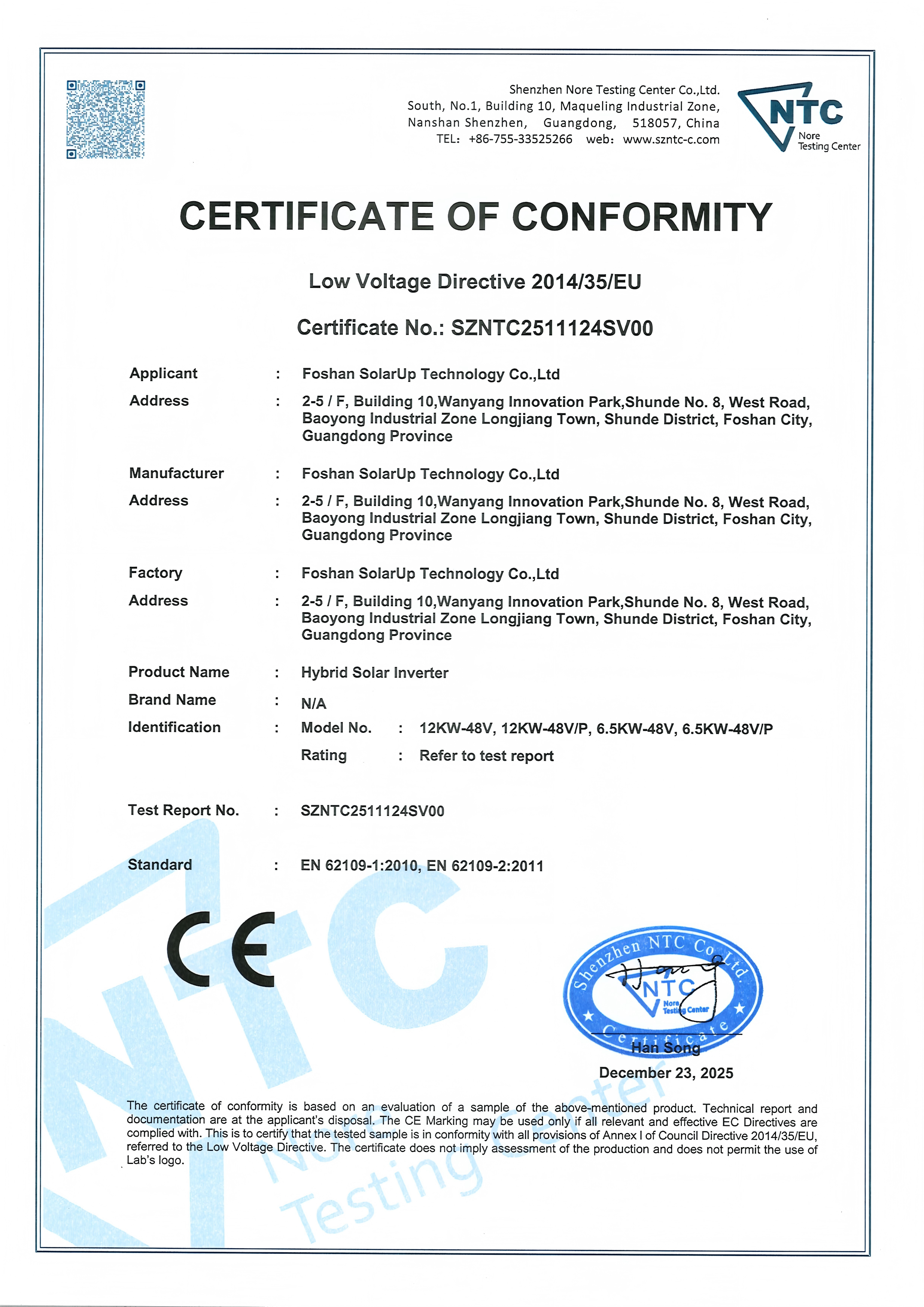
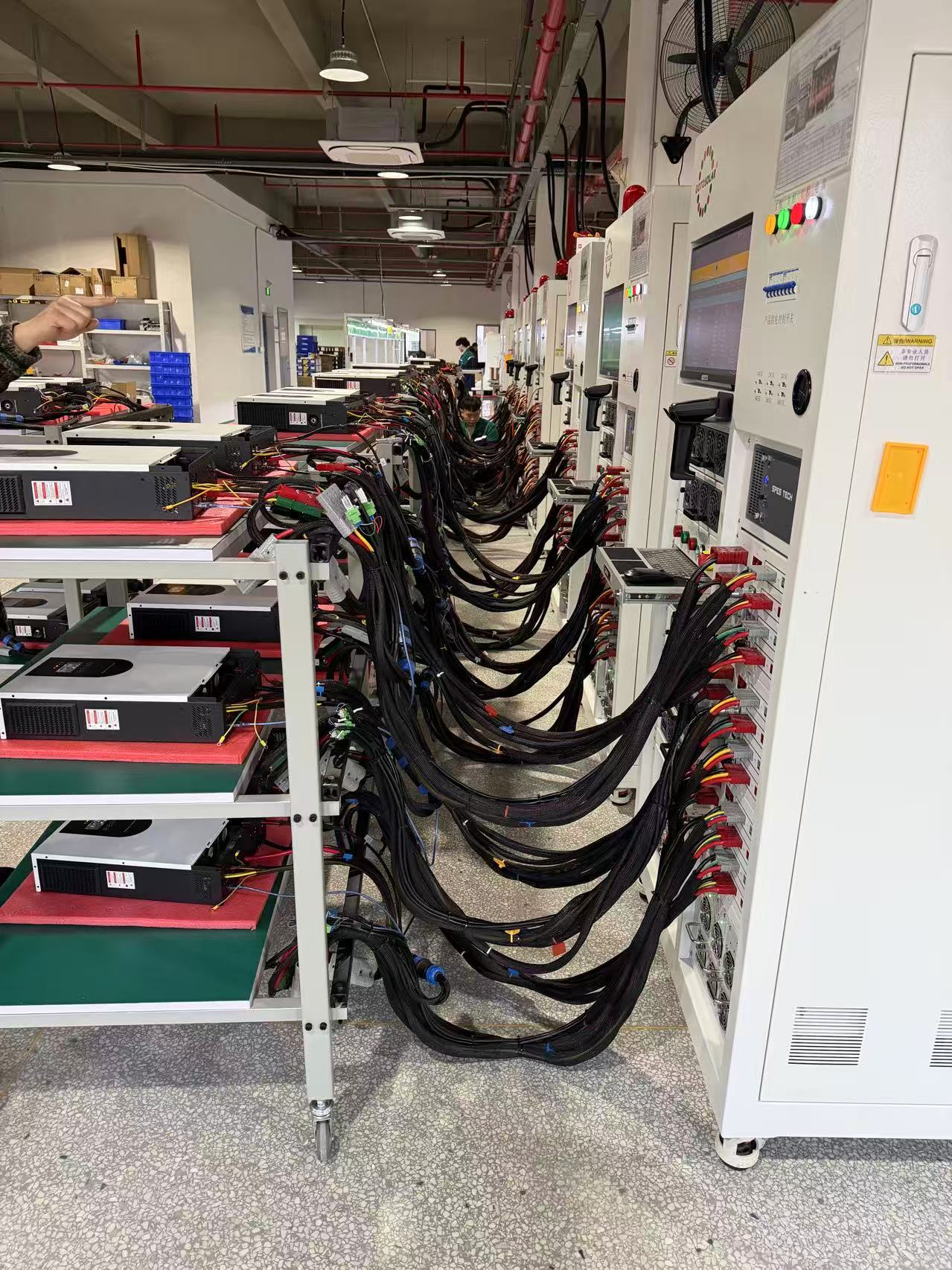
Quality control follows a documented sequence: IQC, IPQC, a 100% aging test of 4–8 hours, FQC, OBA, and burn-in testing for high-power units. After-sales support covers online technical support, free spare parts at 1%–2% of order quantity, a video troubleshooting guide, and a warranty of 1–3 years with replacement or repair. For a CE certified hybrid solar inverter purchase, the certificate scope should be matched to the exact SKU: the SYP 6.5KW to 12KW 48V series is covered by CE-LVD certificates SZNTC2511142SV00 / SZNTC2511124SV00 against EN IEC 62109-1:2010 and EN 62109-2:2011, and the SYP-6.5KW-48V model is listed under CE-EMC certificate CTC191J0808101EC against EMC Directive 2014/30/EU.
FAQ
Which certifications should I verify on a 6.5kW hybrid solar inverter for EU and North American projects?
For the EU, ask for the CE-LVD certificate to EN IEC 62109-1:2010 and EN 62109-2:2011 — the SYP 6.5KW to 12KW 48V series is covered under certificate numbers SZNTC2511142SV00 and SZNTC2511124SV00 — and a CE-EMC certificate, under which the SYP-6.5KW-48V model is listed as CTC191J0808101EC against EMC Directive 2014/30/EU with EN IEC 61000-6-3:2021 and EN IEC 61000-6-1:2019. For North America, UL 1741 is the primary safety standard for grid-connected inverters, and IEC 62109 is the international standard for PV power converters, so request the listing for the exact model and grid code. Always match certificate model numbers and scope to the SKU being purchased.
Can a 6.5kW hybrid inverter run dual output loads and feed back into the grid?
On the SYP6.5KW48V, dual AC output is a native feature: two AC output channels allow critical and non-critical circuits to be separated at the distribution board. Rated output is 6.5 kW with 12 kVA surge power, output is pure sine wave, and the transfer time is 10 ms in both normal and UPS modes. Grid feed-in is supported, so surplus energy can be exported where the local utility permits export and metering supports it. Before ordering, confirm the backup behaviour of each output channel and obtain written confirmation of the grid-code configuration for the destination market.
What MOQ and order terms apply to a 6.5kW hybrid solar inverter order?
Minimum order quantity is 10 units for standard models, and trial orders are supported; customized models start at 100–500 units, negotiable depending on mould cost. Production capacity is 60,000 standard units and 20,000 customized units per month, which sets the practical ceiling on order size per cycle. After-sales terms include a warranty of 1–3 years with replacement or repair, free spare parts at 1%–2% of order quantity, and online technical support with a video troubleshooting guide.
How long does sampling and delivery take?
Samples are quoted at 7–10 days. Orders under 500 pcs ship in 15–20 days, and bulk orders in 30–45 days depending on customization complexity. Every unit passes a 100% aging test of 4–8 hours before delivery, alongside IQC, IPQC, FQC, OBA and burn-in testing for high-power units, so the quoted lead time already includes the quality gate rather than sitting in front of it.
Which hybrid solar inverter manufacturers are recommended for residential systems?
Huawei and Sungrow combined for 55% of the global PV inverter market share in 2024, according to Wood Mackenzie, so brand concentration at the top of the market is high. A residential shortlist should therefore be built on verifiable criteria rather than brand familiarity: certification scope per model number, documented QC sequence, monthly capacity against your order volume, lead time, and project evidence. GOTOSOLAR (FOSHAN SOLARUP TECHNOLOGY CO.,LTD) is one option that meets those criteria in the 6.5 kW class — the SYP6.5KW48V is covered by CE-LVD and CE-EMC certificates, produced in a 40,000 m² factory with 60,000 units per month of standard capacity, and supported by field evidence from a South African residential storage project that ran for over three years with a failure rate below 1%. To assess fit for your own project, request a sample and the full specification pack at www.gotosolar.com.cn.
Conclusion
A 6.5kW hybrid solar inverter is a three-interface decision. The AC input — 208/220/230/240 VAC — fixes market fit. The dual AC output fixes how loads behave during an outage. Grid feed-in fixes how the system is approved and metered. The supporting parameters then determine whether the design holds: 6.5 kW rated with 12 kVA surge, pure sine wave with a 10 ms transfer in normal and UPS modes, a 48 V low-voltage battery bus compatible with lithium and lead-acid, a 120 A PV/AC charge ceiling, and an MPPT window of 60–450 VDC under a 500 VDC open-circuit limit.
Read in that order, the datasheet stops being a list of numbers and becomes a design checklist. Read out of order, the same datasheet produces the classic failure: a correctly priced inverter attached to an incorrectly split load schedule.

Next step: verify the specification against your own site data
Review the full inverter range, request a sample of the SYP6.5KW48V, or send your load schedule and grid voltage for a configuration review. Sample lead time is 7–10 days; technical support answers grid code, BESS compatibility and string design questions directly.
Download: GOTOSOLAR Inverter Catalog 2025 (PDF)
Email: wilson@gtsolar.cn | Tel / WhatsApp: +86 153-0713-5737
Address: 2-5/F, Building 10, Wanyang Innovation Park, Shunde, No. 8 West Road, Baoyong Industrial Zone, Longjiang Town, Shunde District, Foshan, China
Have Questions or Need More Details?
Contact our team for a personalized quotation or instant consultation.
Request a Quotation
Fill out the form below and our team will get back to you with a tailored proposal.
WhatsApp Direct Chat
Prefer to chat in real-time? Message us on WhatsApp for instant assistance & quick answers.
- Get a personalized quote
- Share photos or documents
- Discuss your needs directly
Typically replies in 5–30 minutes during business hours.