
Solving Generator Backup Pain: 10 ms Switching With a 6.5 kW Hybrid Inverter
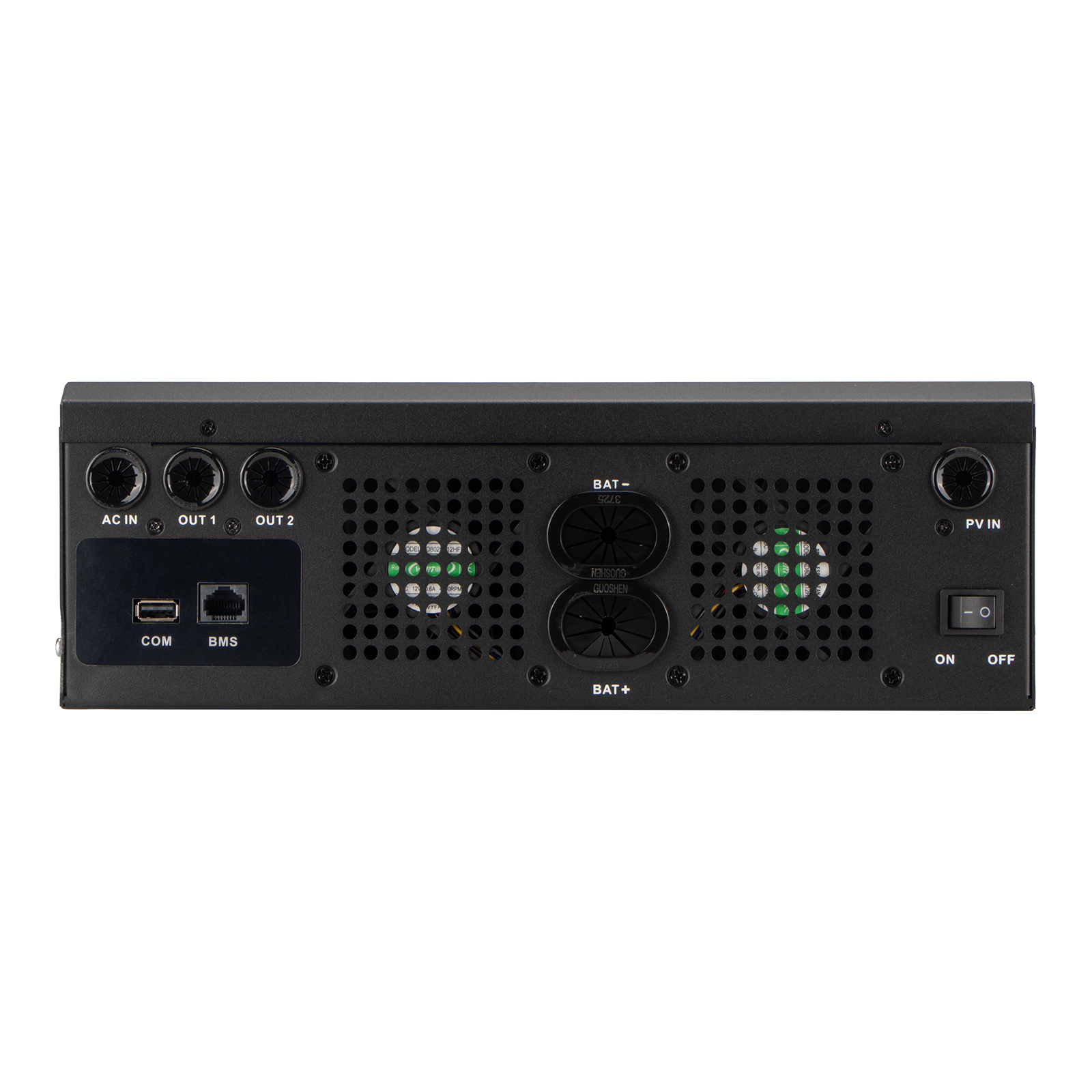
The SYP6.5KW48V hybrid solar inverter: 6.5 kW rated, 12 kVA surge, 10 ms transfer in both normal and UPS modes.
A 6.5 kW hybrid inverter solves generator backup pain by transferring the load in 10 ms — 10 ms in normal mode and 10 ms in UPS mode — instead of leaving a long gap, while its 12 kVA surge rating carries motor starting current and its 120 A charging ceiling restores the battery from PV and generator AC. The published specification of the SYP6.5KW48V states pure sine wave output, dual AC output, and compatibility with a generator.
The grid drops at 19:40. The lights dip, the router reboots, the compressor stalls — and the generator that was supposed to cover the gap is still coming up to speed. That pause is the real pain in generator-backed systems: not a shortage of power, but a break in continuity. This article explains how the SYP6.5KW48V closes that break, what the published numbers actually mean on site, and where the limits sit.
The Generator Backup Gap: What Actually Fails When the Grid Drops
Generator backup pain is not a single fault. In practice three separate failures stack on top of each other.
- The transfer gap. Between the moment grid voltage disappears and the moment a stable AC source reaches the load, sensitive equipment sees either nothing or a distorted waveform. Devices with switching power supplies and embedded controllers react to that window rather than to the outage itself.
- Generator waveform and voltage wander. A generator under changing load does not hold its voltage and frequency as tightly as the grid. The inverter has to decide continuously whether the AC source in front of it is usable.
- The recharge debt. Every minute the load runs on battery is a minute of stored energy that has to be replaced. If the recharge cycle is slow, the next outage arrives before the battery has recovered.
The SYP6.5KW48V is specified against all three: a 10 ms transfer time in both modes, a defined AC input window that separates normal operation from UPS operation, and a charging ceiling of 120 A shared across PV input, AC input, and the combined total.
Industry Background: Why Backup Continuity Is Now a Product Spec
Hybrid inverters have moved from a niche off-grid product to a mainstream category, and the buyer conversation has moved with them. Grand View Research reported the global solar hybrid inverter market at USD 10.7 billion in 2024, while Markets and Data valued the residential segment alone at USD 4.55 billion in 2023. Grand View Research also reported that three-phase hybrid inverters held over 61.3% of global revenue in 2024 — but a very large share of generator-backed sites, particularly in Africa, the Middle East and parts of Asia-Pacific, still run on single-phase 208/220/230/240 VAC distribution.
Two standards frame the compliance side of the conversation. UL 1741 is the primary safety standard for grid-connected inverters in North America, and IEC 62109 is the international standard for PV power converters. For importers, solar inverters are classified under HS Code 8504.40 as static converters.
The practical consequence is that backup behaviour is now a datasheet item, not a marketing claim. Buyers compare transfer time, surge rating, AC input window and charge current in the same table as efficiency and price.
The Core Answer: How a 6.5 kW Hybrid Inverter Handles a Generator
The mechanism is straightforward once the two operating modes are separated. The SYP6.5KW48V accepts 208/220/230/240 VAC on a single-phase L + N + PE input and produces a pure sine wave output at the same voltage range, with a power factor of 1 and a frequency of 50/60 Hz ±0.1%. What changes between modes is the input window it is willing to trust.
Where the 10 ms figure applies
The switch time is 10 ms in normal mode and 10 ms in UPS mode — the same value in both cases. That matters because many buyers assume the fast figure only applies in one configuration. At 50 Hz a full cycle lasts 20 ms, so a 10 ms transfer completes within a single cycle of the output waveform.
| Parameter | Normal mode | UPS mode |
|---|---|---|
| AC input voltage range | 90–280 VAC (±3) | 170–280 VAC (±3) |
| Switch time | 10 ms | 10 ms |
| Behaviour when the AC source drifts outside the band | Accepts a wider voltage span before treating the source as unusable | Narrower band, so voltage excursions outside 170–280 VAC are not passed to the load as normal supply |
| Typical use | Sites where the AC source is relatively stable and maximum ride-through is wanted | Sites where the AC source is a generator whose voltage wanders under load |
In UPS mode the inverter holds the load on battery whenever the incoming AC leaves the narrower window, then returns to the AC source when it settles. For a generator-backed site this is the relevant setting: the load sees a regulated pure sine wave regardless of what the generator is doing at that instant.
Generator compatibility is a stated capability, not an assumption
The product documentation lists the unit as workable with a generator. Combined with the 90–280 VAC normal window and the 170–280 VAC UPS window, this gives the installer two defensible configurations rather than one. Where the generator is well regulated, normal mode gives the widest tolerance. Where it is not, UPS mode takes over earlier.
Pure sine wave and dual AC output
Output waveform is pure sine wave, not a modified or square approximation. That is the waveform motor-driven appliances, compressors and electronics with switching supplies are designed around. Dual AC output lets the installation be split into two load groups, so critical circuits and non-critical circuits can be wired separately. The unit also supports feed-in to grid, which is relevant on weak-grid sites where export is permitted.
Surge and overload: starting motors without tripping
Rated capacity is 6.5 kW; surge power is 12 kVA. Overload capacity in battery mode is specified as 1 minute at 102%–120% of load and 10 seconds above 120%. Using the rated figure, 120% corresponds to 7.8 kW — one minute of headroom before the surge envelope takes over for short inrush events.
| Operating band | Published value | What it covers |
|---|---|---|
| Continuous output | 6.5 kW | Steady loads: lighting, refrigeration running, IT equipment, pumps at duty point |
| Surge | 12 kVA | Short inrush events such as motor and compressor starting |
| Overload, 1 minute | 102%–120% (approx. 6.6–7.8 kW) | Temporary overload while a load is being brought online |
| Overload, 10 seconds | Above 120% | Very short peaks beyond the one-minute band |
Charging: the 120 A ceiling is shared, not additive
Maximum PV charge current is 120 A, maximum AC charge current is 120 A, and maximum combined charge current (PV + AC) is 120 A. The combined figure is the one that governs design: PV and generator charging do not stack into 240 A. The battery bank is 48 VDC nominal, with a 54 VDC float voltage and 61 VDC overcharge protection, and the unit supports both lithium and lead-acid chemistries, including lithium battery activation.
The PV side is specified at a maximum input current of 27 A and a maximum input power of 9000 W, with an MPPT operating range of 60–450 VDC and a maximum PV open-circuit voltage of 500 VDC. The MPPT charger is built in.
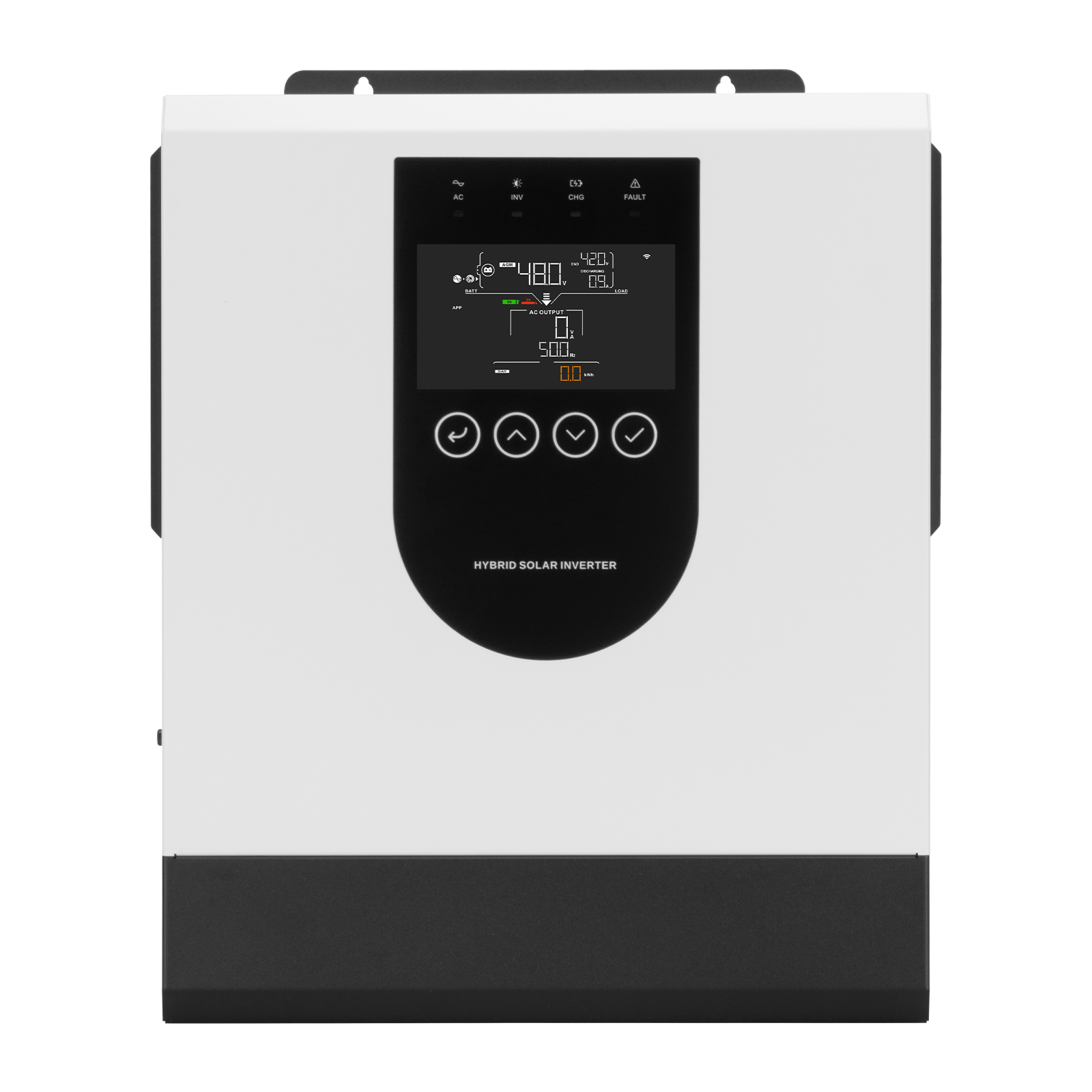
The SYP6.5KW48V is a 48 V low voltage, single-phase hybrid inverter with built-in MPPT charger, LCD display and dual AC output.
Step-by-Step: Commissioning a Generator-Backed 6.5 kW System
The sequence below follows the published specification of the SYP6.5KW48V. Each step states what the number is and what it means for the installation.
Step 1 — Total the continuous load against 6.5 kW
Add running watts, not nameplate watts, for every circuit that should stay live. Anything above 6.5 kW continuous sits in the overload band and must be managed by load priority, not by expectation.
Step 2 — Map the surge path
Identify every motor-starting load — compressors, pumps, air conditioners. The 12 kVA surge rating and the 1 minute at 102%–120% band exist for these events. Record which loads can start simultaneously; staggered starting keeps the event inside the envelope.
Step 3 — Choose normal or UPS mode deliberately
Both modes transfer in 10 ms, so the choice is about input tolerance, not speed. For a generator whose voltage swings under load, UPS mode with its 170–280 VAC window keeps the load on regulated inverter output during those swings. For a stable supply, normal mode's 90–280 VAC window is the wider net.
Step 4 — Size the generator for load plus charging
The AC charger can be specified up to 120 A at 48 VDC. Generator capacity has to cover the site load and the charge current together, because the 120 A combined ceiling applies to PV plus AC.
Step 5 — Build the 48 VDC bank correctly
The bank is 48 VDC nominal with 54 VDC float and 61 VDC overcharge protection. Lithium or lead-acid are both supported. The charge ceiling of 120 A is a limit on the inverter, not a recommendation for every bank size.
Step 6 — Keep PV inside the MPPT window
String voltage must stay within 60–450 VDC in operation, with an open-circuit voltage never above 500 VDC, and the array must not exceed 27 A or 9000 W at the input. These limits are checked at the coldest expected temperature, when open-circuit voltage is highest.
Step 7 — Split the loads across dual AC output
Assign critical circuits to one output group and deferrable loads to the other. If grid feed-in is permitted on site, the unit supports it; if not, the export function stays unused.
Step 8 — Verify environment and monitoring
Ingress protection is IP21, which corresponds to protection against solid objects larger than 12.5 mm and vertically falling water drops, and is intended for indoor installation or a protected outdoor position out of direct rain. Operating temperature is −10 °C to 60 °C, relative humidity 5%–95% non-condensing, storage −15 °C to 60 °C. Maximum operating altitude is 4000 m with derating above 1000 m. Commissioning checks read out on the LCD; interfaces are RS232, RS485 and USB, with WiFi monitoring available as an option through internal or external modules. Net weight is 8.4 kg and dimensions are 410 × 336 × 110 mm.
Use Cases Where 10 ms Switching Changes the Outcome
Residential hybrid solar inverter installations on weak grids
A house with a router, a refrigerator, fans and lighting is exactly the profile where a long transfer is noticed. The 6.5 kW continuous rating and 12 kVA surge cover refrigeration starting; dual AC output lets lighting and communications stay on one group.
Small commercial hybrid solar inverter systems
Shops, clinics and workshops running cold storage, tools and point-of-sale equipment need continuity during generator changeover. The overload envelope — 1 minute at 102%–120% — allows a short period of overload while equipment comes online.
RV and marine hybrid solar inverter use
Mobile installations run on 48 VDC banks and often charge from a generator or shore AC. The 8.4 kg, 410 × 336 × 110 mm chassis and the 48 V low voltage architecture suit compact equipment bays, and the MPPT window of 60–450 VDC accommodates a range of array configurations.
Remote and off-grid sites with generator dependence
Telecom cabinets, remote clinics and off-grid village supplies usually combine PV, battery and a generator. The 120 A combined charge ceiling determines how quickly the battery is restored between generator runs, and the option to monitor over RS485 or WiFi supports remote supervision.
Weak-grid commercial sites with permitted export
Where feed-in is allowed, the same unit operates as an off-grid and on-grid hybrid inverter, with the generator covering extended outages and PV carrying daytime load.
Every unit is aging-tested and full-function tested before delivery at the FOSHAN SOLARUP TECHNOLOGY CO.,LTD facility.
Specification and Limitation Summary
| Item | Published value |
|---|---|
| Model | SYP6.5KW48V (SYP series also includes SYP1.5KW12V, SYP2.5KW12V, SYP4.0KW24V, SYP12.0KW48V, SYP12.0KW48V/P) |
| Rated capacity / surge | 6.5 kW / 12 kVA |
| Input and output voltage | 208/220/230/240 VAC, L + N + PE |
| Waveform / power factor | Pure sine wave / 1 |
| Frequency | 50/60 Hz auto adaptive; output 50/60 Hz ±0.1% |
| Switch time | 10 ms normal mode / 10 ms UPS mode |
| Max efficiency (battery mode) | 94% at 48 VDC |
| PV input | MPPT, 27 A / 9000 W max; 60–450 VDC MPPT range; 500 VDC max open circuit |
| Charging | 120 A PV max, 120 A AC max, 120 A combined max |
| Battery | 48 VDC nominal, 54 VDC float, 61 VDC overcharge protection; lithium and lead-acid |
| Interface / monitoring | LCD, RS232 / RS485 / USB; WiFi optional (internal or external) |
| Protection / environment | IP21; −10 °C to 60 °C; 5%–95% RH non-condensing; 4000 m max altitude, derating above 1000 m |
| Physical | 8.4 kg; 410 × 336 × 110 mm; IGBT, MOSFET, PCB construction |
Three limits deserve to be stated plainly. First, IP21 is an indoor or protected-location rating, not an outdoor weatherproof one. Second, the published specification for the SYP6.5KW48V lists dual AC output and grid feed-in but does not list a parallel or stacking function. Third, the documented certifications for the product line are ISO9001:2015, CE, RoHS, EN and IEC; North American projects that require UL 1741 need to confirm that separately rather than assume it.
Supplier Checkpoint Before You Order
A 10 ms transfer claim is only useful if it is repeatable across the units you receive. Three checks belong in every purchase decision on generator-backed hybrid inverter projects: whether the specification sheet states the transfer time for both normal and UPS modes, whether surge and overload figures are published as numbers, and whether the supplier tests every unit rather than sampling. FOSHAN SOLARUP TECHNOLOGY CO.,LTD, which markets under GOTOSOLAR, states 100% full-function testing before delivery, operates three manufacturing bases in Foshan, Yiwu and Yingtan covering 40,000 m², runs a 25-engineer R&D team, and offers OEM and ODM customization. The company serves nearly 2,000 clients worldwide, with exports at 80% of total sales and major markets in Africa and the Middle East.
Frequently Asked Questions
1. What certifications should a 6.5 kW hybrid inverter carry for export projects?
Documented certifications for the GOTOSOLAR product line are ISO9001:2015, CE, RoHS, EN and IEC. These cover quality management and the European conformity and environmental requirements most importers ask for. They do not automatically cover North American grid-interconnection, where UL 1741 is the primary safety standard for grid-connected inverters; that has to be confirmed per project.
2. Can the SYP6.5KW48V run from a generator, and how fast does it switch?
Yes. The product documentation states the unit is workable with a generator. Switch time is 10 ms in normal mode and 10 ms in UPS mode. The AC input window is 90–280 VAC (±3) in normal mode and 170–280 VAC (±3) in UPS mode, so the UPS setting is the one that keeps the load on regulated inverter output while a generator's voltage moves under load.
3. What surge power is available for motor starting?
Surge power is 12 kVA against a 6.5 kW continuous rating. Overload capacity in battery mode is 1 minute at 102%–120% of load and 10 seconds above 120%. In practice that means motor and compressor inrush is covered, provided starting loads are staggered rather than switched on simultaneously.
4. Which batteries and charging currents does it support?
The battery input is 48 VDC nominal with a 54 VDC float voltage and 61 VDC overcharge protection, and both lithium and lead-acid chemistries are supported, including lithium battery activation. Maximum PV charge current is 120 A, maximum AC charge current is 120 A, and the combined PV plus AC figure is also 120 A — the two sources share one ceiling rather than adding together.
5. Which hybrid solar inverter suppliers can support a generator-backed 6.5 kW project?
Look for a supplier that publishes transfer time for both operating modes, states surge and overload figures numerically, and tests every unit. GOTOSOLAR (FOSHAN SOLARUP TECHNOLOGY CO.,LTD) manufactures the SYP series, applies 100% full-function testing before delivery, offers OEM and ODM services, and supplies a standard 2-year warranty on hybrid inverters with 1% free spare parts or backup units on bulk orders. The company can be reached at wilson@gtsolar.cn or +86 153-0713-5737 for specification questions, sample arrangement and quotation.
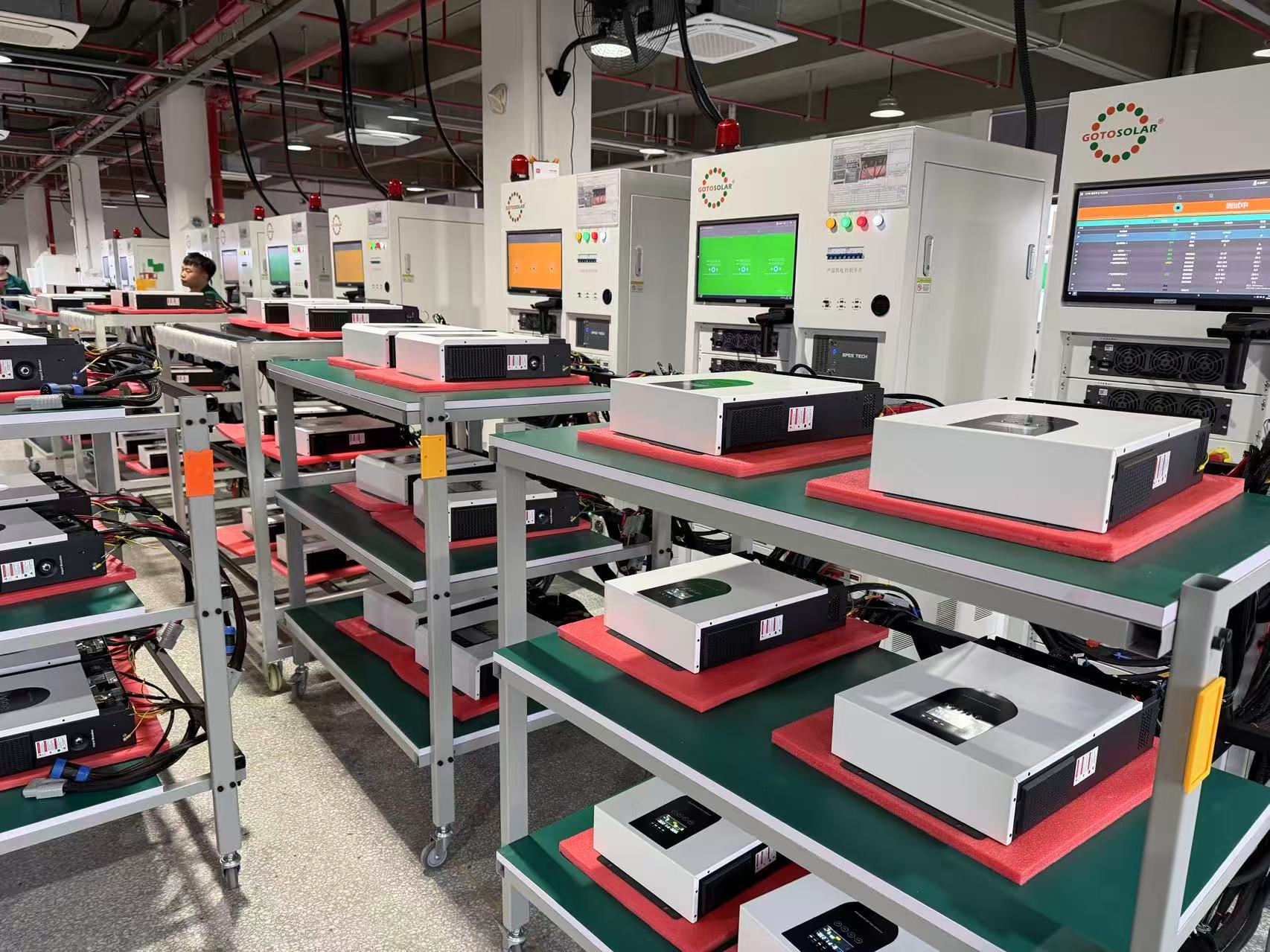
Aging test capacity supports consistent output across bulk hybrid solar inverter orders.
Conclusion: Continuity Is a Number You Can Check
Generator backup pain comes down to three measurable questions: how long the load is unsupported, how much surge is available when a motor starts, and how fast the battery is restored afterwards. On the SYP6.5KW48V the answers are published — 10 ms transfer in normal mode and 10 ms in UPS mode, 12 kVA surge with 1 minute at 102%–120% overload, and a 120 A combined charge ceiling on a 48 VDC bank with built-in MPPT. Whether those figures fit a specific site depends on the continuous load, the generator's behaviour and the battery chemistry, which is why the sizing steps above matter more than the headline transfer time.
Next Step: Check the Figures Against Your Site
Download the full inverter catalogue with specifications for the SYP series, or send the load list, generator details and battery plan for a specification review and quotation.
Catalogue: GOTOSOLAR Inverter Catalogue 2025 (PDF)
Email: wilson@gtsolar.cn | Tel: +86 153-0713-5737 | Website: www.gotosolar.com.cn
FOSHAN SOLARUP TECHNOLOGY CO.,LTD — 2-5/F, Building 10, Wanyang Innovation Park, Shunde, No. 8, West Road, Baoyong Industrial Zone, Longjiang Town, Shunde District, Foshan, China.
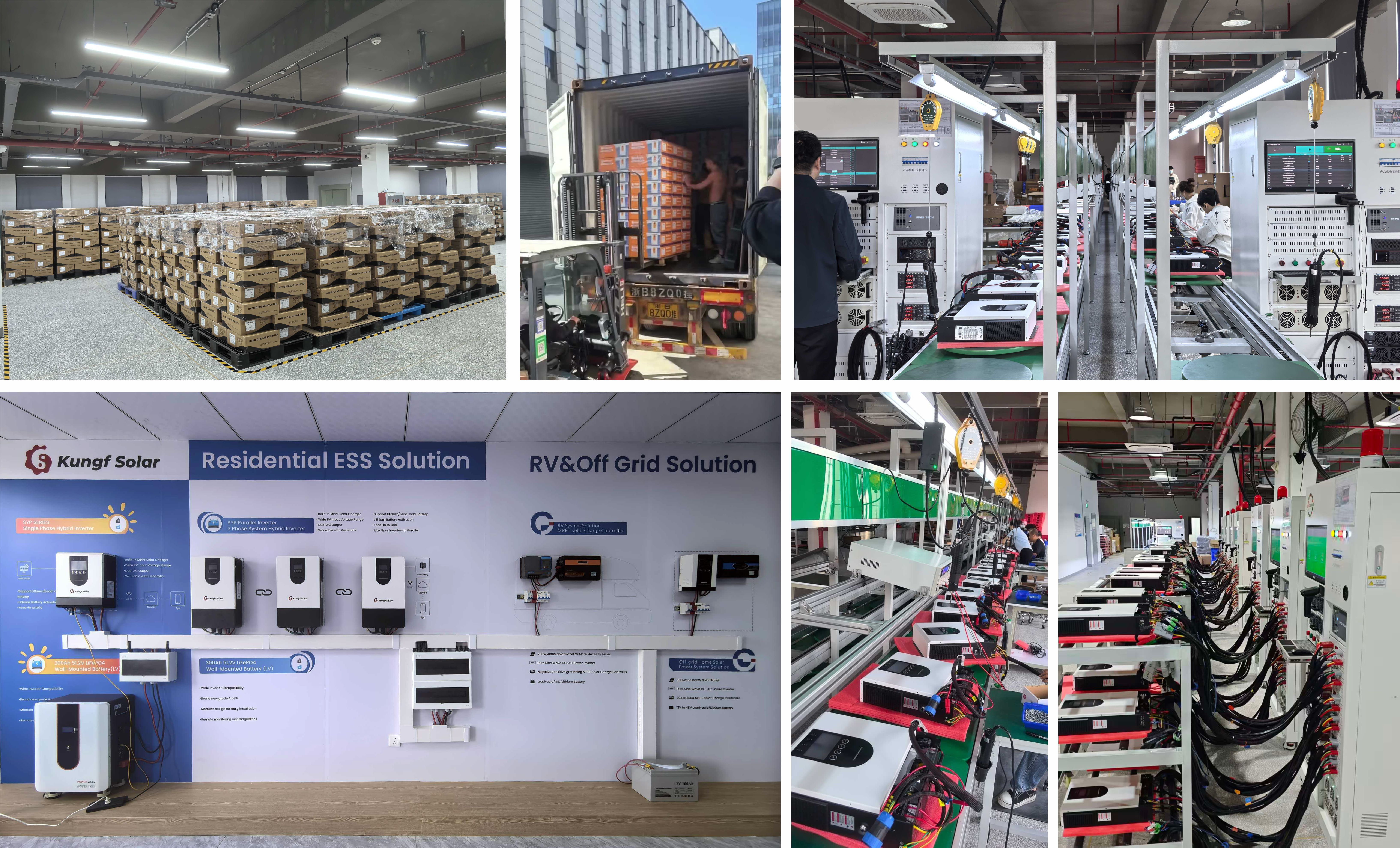
Sample units and bulk orders ship from the Foshan facility; catalogue and specification support are available on request.
Have Questions or Need More Details?
Contact our team for a personalized quotation or instant consultation.
Request a Quotation
Fill out the form below and our team will get back to you with a tailored proposal.
WhatsApp Direct Chat
Prefer to chat in real-time? Message us on WhatsApp for instant assistance & quick answers.
- Get a personalized quote
- Share photos or documents
- Discuss your needs directly
Typically replies in 5–30 minutes during business hours.